

When it comes to commercial roofing, the decision you make today will follow your building for decades. Most owners want a roof that doesn’t leak and doesn’t require constant attention — that’s a fair baseline. But the system you choose determines far more than that: it shapes your energy bills, your maintenance schedule, your insurance premiums, and your total investment over the building’s life.
This guide covers the key differences between metal roof systems and traditional commercial roofing in plain language, so you can make a decision grounded in the full picture — not just the installation quote.
Traditional Commercial Roofing Systems
Traditional commercial roofing covers several distinct systems, each with different performance profiles, ideal applications, and long-term ownership experiences.
BUR (Built-Up Roofing)
One of the oldest flat roof systems, BUR uses multiple layers of bitumen and reinforcing fabric topped with gravel or a mineral cap sheet. It handles heavy foot traffic well and has a proven track record on flat commercial roofs. On the downside, it is one of the heavier roofing options — sometimes reaching 6 pounds per square foot — and it is labor-intensive to install and maintain. Investment varies considerably based on building size and local labor market.
TPO Single-Ply Membrane
TPO has become one of the most popular flat roof options for good reason. Its white reflective surface helps reduce cooling costs, and it installs relatively quickly. The main vulnerability is its heat-welded seams — these are where most failures occur, particularly in climates with repeated freeze-thaw cycles or strong UV exposure. Seam repairs are rarely straightforward.
EPDM Rubber Roofing
EPDM performs well in cold climates, which makes it common in northern regions. Its dark color absorbs heat rather than reflecting it, which increases summer cooling loads. Adhesive seams are the weak point — every freeze-thaw cycle adds stress to the bond, and degradation accumulates over time.
PVC Roofing
PVC membranes offer the strongest chemical resistance of any traditional system, making them the right choice for restaurants, food processing facilities, or anywhere grease exposure is a factor. The trade-off is a higher upfront investment and the risk of brittleness in extreme cold over many years.
Modified Bitumen and Asphalt Shingles
Modified bitumen handles temperature swings reasonably well and suits a range of commercial applications. It comes in torch-applied, cold adhesive, or self-adhesive forms — torch application carries a fire risk during installation that requires careful contractor management. Asphalt shingles appear on smaller commercial buildings with steep slopes but are the shortest-lived option and lose waterproofing capacity as granules shed over time.
Metal Roof Systems for Commercial Buildings
Modern commercial metal roofing is engineered for decades of performance with minimal maintenance. It is not the corrugated agricultural sheet of decades past — today’s systems are tested, certified, and backed by long manufacturer warranties.
Standing Seam — The Gold Standard
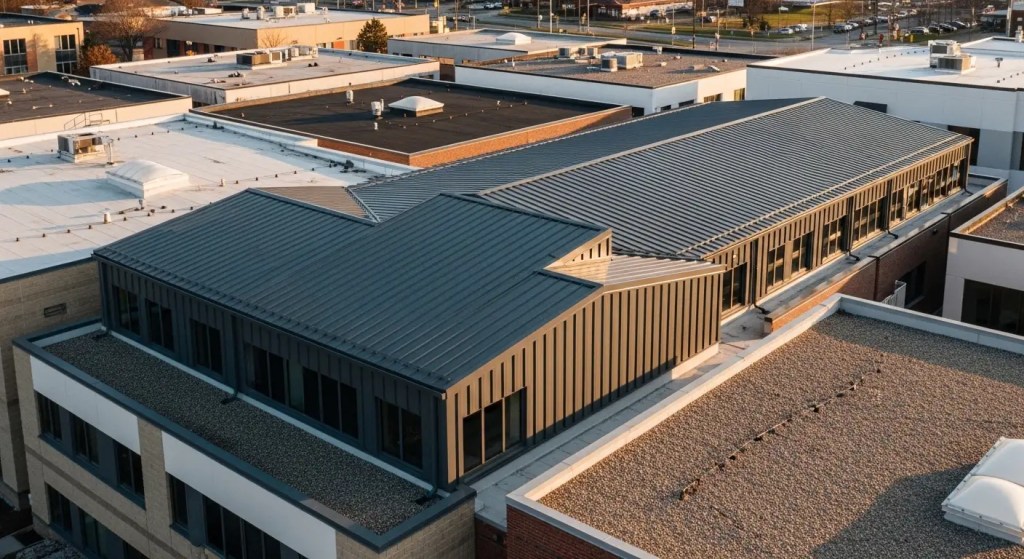
Standing seam panels interlock at raised seams with hidden fasteners, eliminating exposed screw points from the roof surface. This design dramatically reduces leak risk and allows the metal to expand and contract freely with temperature changes through concealed clips — without stressing the seams. It works on slopes as low as 1:12, making it compatible with most commercial buildings. Investment varies based on building size, panel specification, and project complexity, but the long-term value is consistent.
R-Panel and Exposed Fastener Systems
R-panel is the practical, cost-effective side of commercial metal roofing. It works well for warehouses, agricultural buildings, and industrial facilities. The exposed screws are its main maintenance point — sealant washers dry out over time and need periodic inspection. Addressed proactively, this is a manageable maintenance task rather than a serious vulnerability.
Material Options
The metal type matters alongside the panel profile:
- Galvalume Steel — Most common; aluminum-zinc alloy coating provides strong corrosion resistance
- Aluminum — Lightweight, naturally rust-proof; ideal for coastal or high-humidity environments
- Copper — Premium option with 100+ year lifespans; used on institutional and landmark buildings
- Zinc — Sustainable, self-healing patina; growing in popularity for green building projects
At a Glance: Metal vs Traditional Roofing
Factor | Metal Roofing | Traditional Roofing |
Lifespan | 40–70+ years | 15–30 years |
Replacement cycles (50 yrs) | 0–1 | 2–4 full replacements |
Maintenance frequency | Annual inspection | Semi-annual + periodic coatings |
Energy reflectivity | Up to 70% solar reflection | 5–30% (varies by type) |
Wind resistance | 120+ mph rated | Moderate — seams vulnerable |
Hail impact rating | Class 4 (highest) | Varies — typically lower |
Fire rating | Class A (non-combustible) | Class A (most systems) |
Solar panel ready | Yes — no-penetration clamps | Difficult — requires drilling |
End-of-life recyclability | 100% recyclable | Mostly landfill |
Best suited for | Long-term ownership 15+ yrs | Short-term or specific use cases |
What Actually Drives the Roofing Decision
Lifespan and Replacement Cycles
Metal roofing lasts 40 to 70-plus years. Most traditional membrane systems last 15 to 30 years. In a building’s 50-year life, this gap translates to two to four full replacement cycles for traditional roofing versus zero to one for metal. Each cycle means tear-off labor, disposal, reinstallation, and business disruption — costs that compound quietly but significantly over time.
Upfront vs. Lifecycle Investment
Metal roofing carries a higher day-one investment than most membrane alternatives. This is the most common reason owners choose traditional roofing — and it’s a legitimate consideration, especially for shorter ownership horizons. But the full picture changes substantially when you account for replacement cycles, maintenance, energy savings, and insurance advantages over 30 to 45 years.
Metal roofing typically reaches its financial breakeven point within 12 to 18 years. After that point, it is the lower-cost system for the remainder of the building’s life.
Energy Performance
Cool metal roofs reflect up to 70% of solar radiation. Standard asphalt reflects 5 to 30%. For a large commercial building, even a modest improvement in cooling efficiency compounds into meaningful annual savings. Many ENERGY STAR-qualified metal systems also qualify for energy efficiency tax credits, reducing the effective investment further.
Wind, Hail, and Fire Performance
Standing seam metal is rated to 120-plus mph wind uplift. Class 4 impact-rated steel and aluminum panels offer the highest available hail resistance. Metal is non-combustible and carries a Class A fire rating without additional coatings. Together, these properties represent the strongest risk profile available for commercial roofing — and many insurers recognize this with premium discounts.
Solar Readiness
Standing seam is the only commercial roofing system that supports non-penetrating solar panel mounts. Clamp-style hardware attaches directly to the raised seams with no holes in the roof surface — protecting the warranty and eliminating the most common cause of solar-related leaks. If rooftop solar is in your 10-year plan, the roofing decision and the solar decision are connected.
Cold Climate Performance — Why It Matters More
For commercial buildings in Minnesota and the upper Midwest, weather performance deserves its own conversation. The region’s winters impose conditions that expose the weakest points of every roofing system.
Snow Shedding and Ice Dams
Metal’s smooth surface sheds snow naturally instead of letting it pack and compress. This prevents ice dam formation at the eaves — one of the most damaging and expensive winter problems for buildings with membrane or asphalt roofing. With properly installed standing seam, ice dams are rarely an issue.
Freeze-Thaw Cycles
Minnesota typically sees 50 to 100-plus freeze-thaw cycles annually. This is brutal on adhesive seam systems — every cycle adds stress to the bond. Metal roofing’s concealed clip system accommodates thermal movement freely, without any stress on seams or fasteners. This is why metal consistently outperforms membrane systems in cold climates over a 20 to 30 year window.
Wind and Hail
Severe storms regularly produce 60 to 80 mph gusts across the region. Standing seam panels rated to 120-plus mph distribute wind load more evenly than exposed fastener systems or membrane seams. Class 4 impact-rated metal panels provide the strongest available protection during hail events — which also translates directly to lower insurance premiums for qualifying buildings.
Year-to-Year Roofing Ownership: What to Expect
Metal Roofing
Annual inspection covers most of what a standing seam roof needs: check flashings at penetrations, clear gutters and drains, look for visible damage after severe storms. With no exposed fasteners on the field of the roof, there are very few points where water can work its way in. This simplicity compounds over 40 years into a meaningful reduction in time, attention, and spending.
Traditional Roofing
TPO and EPDM membranes require semi-annual seam inspections at minimum — because seams are where failures originate. BUR coatings need reapplication every five to seven years. Asphalt shingles need granule loss assessments and blister repairs that increase in frequency as the roof ages. None of these individual tasks is overwhelming, but together over 20 years they represent a substantially higher maintenance burden than metal.
Emergency Repairs
Membrane punctures from hail, debris, or HVAC service foot traffic are common on flat traditional roofs — and they’re often invisible until interior damage appears. Standing seam metal rarely fails in the field. When metal needs repair, it’s almost always a flashing issue at a penetration: localized, identifiable, and straightforward to fix.
LEED and Sustainability Factors in Roofing Systems
Metal roofing contributes to multiple LEED credit categories — Energy and Atmosphere, Heat Island Reduction, Materials and Resources, and Water Efficiency (smooth surfaces ideal for rainwater collection). Standing seam systems also support solar PV integration without roof penetrations, which contributes to Innovation credits.
At the end of its life, metal roofing is 100% recyclable and retains scrap value. Traditional asphalt shingles and most membrane systems are not recyclable in most regions — approximately 20 billion pounds of asphalt roofing waste enters US landfills every year. For building owners with sustainability commitments, this difference is meaningful.
Which System Is Right for Your Building?
Metal roofing is the right call for most commercial buildings — but not every one. Here is a straightforward way to think about it.
Metal Roofing Makes the Most Sense When:
- You plan to own or operate the building for 15 or more years
- Your region experiences heavy snow, high winds, hail, or wide temperature swings
- Energy efficiency and sustainability are priorities for your business or tenants
- You’re considering rooftop solar within the next decade
- Your building is a warehouse, industrial facility, agricultural structure, office, hangar, or retail center
- LEED certification is a project goal
Traditional Roofing May Make More Sense When:
- You have a short-term occupancy plan and upfront investment is the primary constraint
- Your building has specific chemical or grease exposure that makes PVC the right specialty solution
- Historical preservation requirements dictate specific materials
- The building has a planned demolition timeline within 10 to 15 years
Before you decide, ask for a life-cycle cost analysis — not just an installation quote. The number that matters is what you spend over 30 to 45 years across all the systems you’re considering. That single comparison often shifts the decision. |
Installation — Key Considerations
The Roof-Over Recovery Option
A standing seam metal system can often be installed directly over existing membrane or asphalt roofing — no tear-off required. This eliminates tear-off labor, disposal cost, and business disruption during re-roofing. Recovery systems like the McElroy 238T are specifically designed for this application and deliver 60-plus year lifespans over existing substrates. When tear-off savings are factored in, the total investment for a metal recovery is often competitive with a traditional single-ply replacement.
Common Installation Mistakes to Avoid
- Flashing details at penetrations: Most metal roof leaks originate at HVAC curbs, vents, or pipe boots — not in the field of the panel. Flashing specs must be detailed in the contract.
- Wrong panel gauge for the climate: Lighter gauge panels that perform adequately in mild climates are not appropriate for buildings dealing with heavy snow loads and 120°F+ temperature swings seasonally.
- Insufficient insulation: Under-insulated metal roof assemblies underperform on energy efficiency and can develop condensation issues. Insulation R-value should be specified in the proposal.
- Unverified installer certification: Standing seam installation requires certified crews. Manufacturer certifications from companies like McElroy, Butler, or Nucor unlock manufacturer-backed weather tightness warranties.
Choosing the Right Contractor
A well-specified roofing system installed by the wrong contractor is still a problem. Here is what to look for:
- Documented commercial project history with references from installations at least 5–10 years old
- Manufacturer certifications — these are not just a credential, they unlock warranty coverage that un-certified installers cannot offer
- A proposal that specifies panel gauge, profile, coating type, insulation R-value, flashing detail plan, and complete warranty terms
- Local climate experience — a contractor who knows your region’s winters will specify the right insulation assembly, ice barrier underlayment, and clip spacing without being prompted
Systems West Inc. — Commercial Roofing
At Systems West, we specialize in commercial metal building construction and roofing systems across Central Minnesota. Our work covers warehouses, aircraft hangars, agricultural buildings, industrial facilities, office and retail buildings, and community structures. We also install metal recover systems for buildings that need a new roof without the disruption of a full tear-off.
We serve Hutchinson, Litchfield, Willmar, St. Cloud, and the surrounding communities throughout Central Minnesota. If you’d like to talk through what makes sense for your building, give us a call at 320-693-8779 or visit systemswestinc.com.
Conclusion
When you evaluate lifespan, lifecycle investment, maintenance burden, energy performance, weather resilience, and end-of-life recyclability — metal roofing leads in most categories for most commercial buildings. That’s not a marketing position; it’s what the full-picture analysis consistently shows. The right answer still depends on your specific building, ownership timeline, and capital situation. If you’re planning to own a commercial building in Minnesota or the northern Midwest for 15 or more years, the case for metal is strong. If your situation involves a shorter horizon, a specialty use case, or a constrained upfront budget, traditional roofing may be the more practical starting point.
Frequently Asked Questions
How long does a commercial metal roof last?
Commercial metal roof lasts 40 to 70-plus years depending on material. Galvalume steel: 40–70 years. Aluminum: 50+ years. Copper: 100+ years. Traditional membrane systems average 15–30 years with proper maintenance.
Is the upfront investment significantly higher for metal?
Yes — metal carries a higher day-one investment than most membrane alternatives. But over a 30 to 45 year window, the combination of fewer replacement cycles, lower maintenance, energy savings, and insurance advantages typically makes metal the lower-cost system. The break even point is usually 12 to 18 years.
Can metal roofing be installed over existing commercial roofing?
Yes. Standing seam recover systems install directly over existing membrane or asphalt roofing, eliminating tear-off cost and business disruption. They deliver 60-plus year lifespans on the new system.
Is metal roofing loud during rain or hail?
In properly insulated commercial assemblies, sound dampening from insulation layers makes a metal roof no louder than other roofing systems during rain. The noise concern mainly applies to uninsulated agricultural buildings, not commercial construction.
Does metal roofing qualify for LEED points?
Yes — multiple categories including Energy and Atmosphere, Heat Island Reduction, Materials and Resources, Water Efficiency, and Innovation credits for solar-ready systems.
What are the main limitations of commercial metal roofing?
The primary consideration is upfront investment, which varies with building size, panel type, and project complexity. Metal also requires certified installation crews to ensure warranty coverage. Lighter-gauge aluminum and copper panels can dent in severe hail, though steel panels hold up well under Class 4 impact testing.
How often does a metal roof need maintenance?
Annual inspection is typically sufficient for standing seam systems. Check flashings, clear gutters and drains, inspect after severe storms. Traditional membrane roofing needs semi-annual inspections at minimum, increasing in frequency as the system ages.