


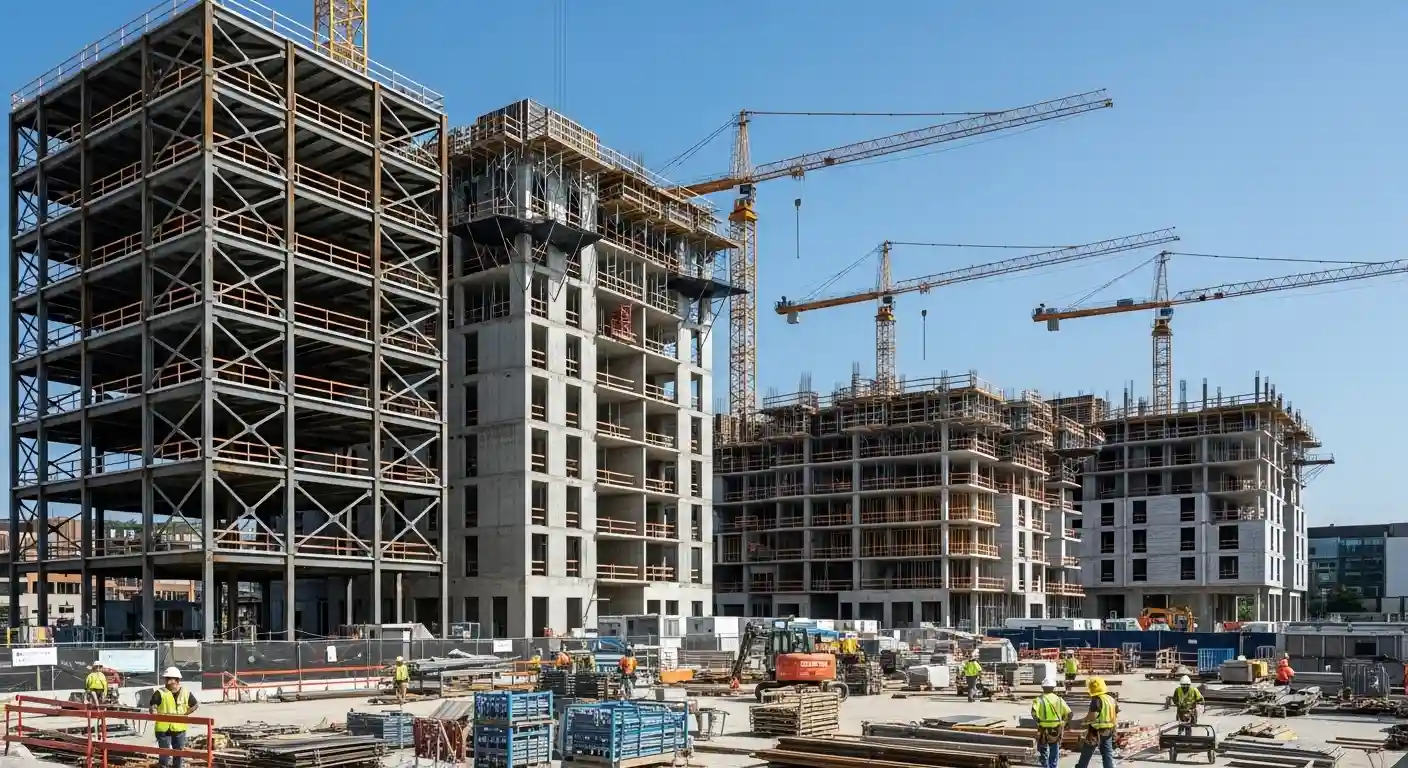
Construction is the process of turning plans and materials into usable structures, but not all buildings are constructed the same way. The International Building Code (IBC) recognizes five main types of building construction: Type I (Fire-Resistive), Type II (Noncombustible), Type III (Ordinary), Type IV (Heavy Timber), and Type V (Wood-Frame). These classifications are primarily based on the materials used and their required fire-resistance characteristics.
Each construction type has different requirements for structural elements, fire resistance, and permitted applications. Understanding these differences helps building owners, designers, and contractors evaluate materials, plan projects, and account for applicable code requirements. Systems West brings commercial and industrial construction experience to projects where material selection, structural planning, and building code requirements need to be considered from the start.
What Are the 5 Types of Building Construction?
The five main types of building construction are Type I, Type II, Type III, Type IV, and Type V. They are classified based on the materials used in the building and the fire-resistance requirements for structural elements. The five types range from Type I, which has the highest fire-resistance requirements, to Type V, which commonly uses combustible wood framing.
Here is a quick overview of each construction type:
- Type I – Fire-Resistive: Uses structural materials with high fire-resistance ratings, commonly including reinforced concrete and protected steel. It is often used for high-rise buildings and other structures where higher fire resistance is required.
- Type II – Noncombustible: Uses noncombustible materials for the primary structural elements, such as steel, concrete, and metal assemblies. The required fire resistance varies between Type IIA and Type IIB.
- Type III – Ordinary: Uses noncombustible materials for exterior walls while interior structural elements may use wood or other combustible materials. It is common in some commercial buildings and older structures.
- Type IV – Heavy Timber: Uses large, solid or engineered wood members that meet specific size and fire-performance requirements. This type is often associated with mass timber and heavy timber construction.
- Type V – Wood-Frame: Allows combustible materials for structural elements, including wood framing. It is commonly used for houses and other smaller buildings.
Quick Reference: Types of Building Construction
Use this table as a quick summary of the five construction types before reviewing each in detail below.
| Construction Type | Common Structural Materials | Fire-Resistance Level* | Typical Applications |
|---|---|---|---|
| Type I | Concrete, protected steel | Highest | High-rise and large commercial buildings |
| Type II | Steel, concrete, metal assemblies | Varies | Commercial and industrial buildings |
| Type III | Masonry exterior walls, wood interior framing | Varies | Commercial buildings and mixed-use structures |
| Type IV | Heavy timber, mass timber | Varies | Commercial, residential, and mixed-use buildings |
| Type V | Wood framing and other combustible materials | Generally lower | Residential and smaller commercial buildings |
*Fire-resistance requirements vary by construction subtype, building element, occupancy, height, area, and the applicable building code.
What Is Type I Fire-Resistive Construction?

Type I construction is a fire-resistive building construction type in which the primary structural elements are required to have high fire-resistance ratings. These elements can include structural frames, columns, beams, floors, and roofs. Common materials include reinforced concrete and protected structural steel. Type I construction is designed to maintain structural stability for longer during a fire, giving occupants more time to evacuate and firefighters more time to respond.
Type I construction is divided into Type IA and Type IB. Both provide high levels of fire resistance, but the required ratings for specific building elements can differ. The exact ratings depend on the applicable building code, occupancy, building height, and area.
Type IA Construction
Type IA construction has the higher fire-resistance requirements within Type I construction. Structural elements such as the building frame, columns, floors, and roof are generally required to provide significant fire resistance. Reinforced concrete and protected steel are common choices because they can be designed to meet these requirements.
Type IA construction is often used when a project has demanding fire-resistance requirements, such as taller buildings or certain large commercial structures. The required ratings are determined by the applicable edition of the International Building Code and the building’s specific characteristics.
Type IB Construction
Type IB construction also provides a high level of fire resistance but generally has lower required fire-resistance ratings for certain building elements than Type IA. It may use similar materials, including reinforced concrete and protected steel, but the protection requirements can differ depending on the structural element.
The distinction between Type IA and Type IB does not simply mean that one uses different materials. Both can use similar structural systems, while the required fire-resistance ratings determine the specific classification. Project conditions and applicable code provisions must be reviewed to determine which subtype applies.
Common Applications of Type I Construction
Type I construction is commonly found in high-rise buildings, large commercial buildings, office buildings, hospitals, hotels, and other structures where high fire resistance is required. Concrete and protected steel can provide the fire-resistance performance needed for these larger structures while supporting significant structural loads.
The appropriate construction type depends on factors such as occupancy, building height, floor area, fire protection systems, and local building code requirements. For commercial and industrial projects, these requirements should be considered during the planning and design stages.
What Is Type II Noncombustible Construction?
Type II construction uses noncombustible materials for its primary structural elements, such as steel, concrete, and metal assemblies. Unlike Type I construction, Type II buildings generally have lower required fire-resistance ratings for structural elements. Type II is divided into Type IIA and Type IIB, with the main difference being the amount of required fire-resistance protection.
Type IIA Construction
Type IIA construction has higher fire-resistance requirements than Type IIB construction. Structural elements such as the frame, bearing walls, floors, and roof are constructed with noncombustible materials and must meet the fire-resistance ratings specified by the applicable building code.
Steel and concrete are common materials in Type IIA buildings. Structural steel may require fire protection, such as spray-applied fire-resistive materials or other approved systems, when needed to meet the required rating. Type IIA is often used for commercial buildings where noncombustible construction and greater fire resistance are required.
Type IIB Construction
Type IIB construction uses noncombustible structural materials but generally does not require the same level of fire-resistance rating as Type IIA. Structural steel, concrete, and other approved noncombustible materials may be used, depending on the building’s design and code requirements.
Because Type IIB generally has fewer fire-resistance requirements for structural elements, it can allow simpler and more economical construction in buildings where the applicable code permits it. The specific requirements still depend on factors such as occupancy, building height, area, and fire protection systems.
Type IIA vs. Type IIB Construction
The main difference between Type IIA and Type IIB construction is the required fire resistance, not simply the materials used. Both types use noncombustible materials, but Type IIA generally requires greater fire-resistance protection for structural elements.
| Feature | Type IIA | Type IIB |
|---|---|---|
| Primary materials | Noncombustible | Noncombustible |
| Fire resistance | Higher requirements | Lower requirements |
| Structural steel | May require fire protection | May require less or no fire protection depending on code |
| Typical use | Commercial buildings with greater fire-resistance requirements | Commercial and industrial buildings where code permits |
The actual fire-resistance ratings are determined by the applicable building code and the building’s specific characteristics.
Common Applications of Type II Construction
Type II construction is commonly used for commercial, industrial, retail, warehouse, and other nonresidential buildings where noncombustible structural materials are required or preferred. Steel framing is particularly common because it can provide long spans and flexible layouts.
The choice between Type IIA and Type IIB depends on the project’s occupancy, height, area, fire-resistance requirements, and applicable code provisions. These factors should be evaluated during the planning and design stages of a commercial construction project.
What Is Type III Ordinary Construction?
Type III construction, also called ordinary construction, uses noncombustible materials for exterior walls while some interior structural elements can be combustible. Exterior walls are typically made from materials such as masonry or concrete, while interior framing, floors, and roofs may use wood. This combination provides a noncombustible exterior with more flexibility in interior construction.
Type IIIA Construction
Type IIIA construction has higher fire-resistance requirements than Type IIIB. Its exterior walls are built with noncombustible materials, while interior structural elements may include wood or other approved combustible materials. The required fire-resistance ratings vary by structural element and are determined by the applicable building code.
Type IIIB Construction
Type IIIB construction also uses noncombustible exterior walls but generally has lower fire-resistance requirements than Type IIIA. Interior structural elements can include combustible materials such as wood, subject to the applicable code requirements. This combination is often found where a masonry or concrete exterior is paired with conventional wood interior framing.
Common Applications of Type III Construction
Type III construction is commonly used for commercial buildings, mixed-use buildings, restaurants, retail spaces, and other structures where noncombustible exterior walls are required while combustible interior framing is permitted. It is also found in many older buildings that combine masonry exterior walls with wood floors and roof systems. The appropriate subtype depends on the building’s occupancy, size, height, and applicable fire-resistance requirements.
What Is Type IV Heavy Timber Construction?

Type IV construction, commonly known as heavy timber construction, uses large wood or mass timber structural members that meet specific size and fire-resistance requirements. Unlike Type V wood-frame construction, Type IV relies on substantial timber members that can provide predictable fire performance when designed and built according to applicable code requirements.
Materials Used in Heavy Timber Construction
Heavy timber buildings can use large solid-sawn timber, structural composite lumber, and mass timber products for elements such as columns, beams, floors, and roofs. The specific materials, dimensions, connections, and protection requirements depend on the applicable Type IV subtype and building code.
Fire Performance of Heavy Timber Construction
Heavy timber and mass timber can perform differently in a fire than smaller wood framing. Large wood members can form a char layer on their exposed surfaces, which can slow the rate at which fire affects the remaining wood. However, fire performance depends on member size, connections, protection, fire exposure, and the requirements of the applicable building code.
Common Applications of Type IV Construction
Type IV construction is commonly used for commercial buildings, offices, residential buildings, mixed-use developments, and other projects designed around heavy timber or mass timber structural systems. Its exposed wood elements can also be part of the architectural design while providing the structural capacity required for the building.
What Does Research Say About Building Construction Materials?
Research examining 70 buildings in North America found that materials such as concrete, steel, masonry, and wood make up major parts of building construction and can vary by building type and structural element. The study organized material data across elements such as foundations, structural systems, floors, walls, and other building components. This supports the broader role of material selection in understanding building construction, although the study’s classification system is different from the five construction types defined by the International Building Code.
What Is Type V Wood-Frame Construction?
Type V construction is a building construction type that permits combustible materials for structural elements, including wood framing. It is one of the most common construction types for residential buildings and is also used for some commercial structures. Type V is divided into Type VA and Type VB, with Type VA generally having higher fire-resistance requirements than Type VB.
Type VA Construction
Type VA construction uses combustible structural materials while requiring fire-resistance ratings for the major structural elements specified by the building code. Wood framing can be used for walls, floors, roofs, and other structural components, provided the construction meets the applicable requirements.
Type VB Construction
Type VB construction also permits combustible structural materials but generally has fewer fire-resistance requirements than Type VA. Wood framing is commonly used throughout the structure, making this type suitable for buildings where the applicable code allows combustible construction with limited or no required fire-resistance ratings for certain elements.
Type VA vs. Type VB Construction
The main difference between Type VA and Type VB construction is the level of required fire resistance. Both can use wood framing and other combustible materials, but Type VA generally requires greater fire-resistance protection for structural elements.
| Feature | Type VA | Type VB |
|---|---|---|
| Structural materials | Combustible materials permitted | Combustible materials permitted |
| Wood framing | Common | Common |
| Fire-resistance requirements | Higher | Lower |
| Typical use | Residential and commercial buildings | Residential and smaller commercial buildings |
The exact requirements depend on the building’s occupancy, height, area, and applicable building code.
Common Applications of Type V Construction
Type V construction is commonly used for single-family homes, multifamily housing, apartments, townhouses, and smaller commercial buildings. Wood framing makes it adaptable to many building layouts and can simplify construction where local codes permit this type of construction.
How Do the Five Building Construction Types Compare?
The five building construction types mainly differ in the materials allowed, their combustibility, required fire resistance, and the types of buildings where they are commonly used. Type I provides the highest level of fire resistance, while Type V permits the widest use of combustible structural materials. Types II, III, and IV fall between these classifications, with different requirements for exterior walls, interior structural elements, and fire resistance.
| Construction Type | Primary Structural Materials | Combustibility | Fire-Resistance Requirements | Typical Applications |
|---|---|---|---|---|
| Type I – Fire-Resistive | Reinforced concrete, protected steel | Noncombustible | High | High-rise, office, hospital, and large commercial buildings |
| Type II – Noncombustible | Steel, concrete, metal assemblies | Noncombustible | Varies by subtype | Commercial, industrial, retail, and warehouse buildings |
| Type III – Ordinary | Masonry or concrete exterior walls, wood interior elements | Mixed | Varies by subtype | Commercial, mixed-use, and older buildings |
| Type IV – Heavy Timber | Heavy timber and mass timber | Combustible | Based on specific timber and fire-performance requirements | Commercial, residential, and mixed-use buildings |
| Type V – Wood-Frame | Wood framing and other combustible materials | Combustible | Generally lower than Types I-IV | Houses, apartments, townhouses, and smaller commercial buildings |
The construction type selected for a building depends on more than the structural material. Occupancy, building height, floor area, fire-resistance requirements, and applicable building codes can all affect which construction type is permitted. The specific requirements also vary between subtypes, such as Type IA and IB or Type VA and VB, so the applicable code should be reviewed during project planning and design.
What Is the Difference Between Type A and Type B Construction?
In the International Building Code, the A and B designations identify different fire-resistance requirements within several construction types. In general, the “A” subtype has greater required fire resistance than the corresponding “B” subtype. This applies to Type I, Type II, Type III, and Type V construction.
The difference does not necessarily mean that Type A and Type B buildings use different primary materials. For example, both Type IIA and Type IIB can use steel and concrete. The key difference is the required fire-resistance rating of specific structural elements, which can affect material protection, construction methods, and project design.
Type IA vs. Type IB
Type IA has higher fire-resistance requirements than Type IB. Both are fire-resistive construction types and can use materials such as reinforced concrete and protected structural steel. The required ratings for structural elements such as the frame, floors, and roof differ between the two subtypes.
Type IIA vs. Type IIB
Type IIA has higher fire-resistance requirements than Type IIB. Both are classified as noncombustible construction and commonly use steel or concrete. Type IIB generally permits lower fire-resistance requirements for certain structural elements where the applicable code allows it.
Type IIIA vs. Type IIIB
Type IIIA has higher fire-resistance requirements than Type IIIB. Both types typically have noncombustible exterior walls while allowing combustible materials for certain interior structural elements. The primary difference is the level of fire-resistance required for those building elements.
Type VA vs. Type VB
Type VA has higher fire-resistance requirements than Type VB. Both types permit combustible structural materials, including wood framing. Type VA requires greater fire-resistance protection for specified structural elements, while Type VB generally has fewer required fire-resistance ratings.
Confirming the Required Fire-Resistance Ratings
The exact fire-resistance ratings are determined by the applicable edition of the International Building Code, along with factors such as occupancy, building height, floor area, and the individual building elements being evaluated. Always check the requirements that apply to the specific project rather than assuming that every A or B subtype has the same ratings.
What Determines a Building's Construction Type?
A building’s construction type is determined by a combination of its structural materials, required fire resistance, occupancy, height, area, and applicable building code requirements. These factors help determine which construction classification is permitted and what fire-resistance ratings are required for different structural elements.
Structural Materials
The materials used for major structural elements are a key factor in determining construction type. These can include columns, beams, bearing walls, floors, roofs, and exterior walls. Depending on the classification, buildings may use noncombustible materials such as concrete and steel, or combustible materials such as wood.
Fire-Resistance Requirements
Required fire-resistance ratings also affect the construction type. Structural elements may need to maintain their stability and performance for a specified period during a fire. The required rating can vary between construction types and subtypes, with factors such as occupancy, building height, and area affecting the requirements.
Building Occupancy and Use
How a building is used can affect its construction requirements. The building code assigns occupancies based on uses such as residential, business, educational, institutional, mercantile, and industrial. Some occupancies have greater fire or life-safety considerations, which can affect allowable construction types and required fire resistance.
Building Height and Area
The height and floor area of a building can influence which construction types are allowed and what fire-resistance ratings are required. Taller or larger buildings may have more demanding requirements than smaller structures. Code provisions can also allow certain increases in allowable height or area when conditions such as automatic sprinkler protection are met.
Local Building Code Requirements
The final construction classification must be determined using the building code adopted by the local authority having jurisdiction (AHJ). The International Building Code provides a widely used framework, but jurisdictions can adopt different editions, amendments, or additional requirements. Before construction begins, the project team should verify the applicable local requirements with the relevant building department or code official.
How Systems West Helps With Commercial Construction
Systems West provides commercial and industrial construction services focused on practical project planning, structural requirements, materials, and applicable building requirements. From early planning to construction, the team works with clients to coordinate the key elements needed for a well-planned commercial or industrial project.
Choosing the right construction approach requires more than selecting materials. Project scope, structural needs, site conditions, code requirements, and long-term use all need to be considered before construction begins. Systems West can help evaluate these factors and coordinate the construction process based on the needs of your project.
Planning a commercial or industrial construction project? Contact Systems West to discuss your project requirements and learn how its construction team can help move your plans from design to construction.
Conclusion
The five main building construction types – Type I, Type II, Type III, Type IV, and Type V – differ mainly in their structural materials, combustibility, and fire-resistance requirements. Understanding these classifications helps building owners, designers, and contractors evaluate construction options and understand which requirements may apply to a project.
The right construction type depends on factors such as building use, height, floor area, structural materials, fire protection, and local building code requirements. For commercial and industrial projects, planning these requirements early can help avoid design changes and construction delays. If you are planning a commercial or industrial building, contact Systems West to discuss your project and construction requirements with an experienced team.
Frequently Asked Questions
What construction type is most common for commercial buildings?
The most common construction type for a commercial building depends on its size, occupancy, location, and applicable building code. Type II and Type III construction are commonly used for commercial buildings, while Type I is often used for larger or taller structures that require greater fire resistance.
What construction type is used for high-rise buildings?
Type I construction is commonly used for high-rise buildings because it provides high fire-resistance requirements for major structural elements. The specific construction type permitted for a high-rise project depends on the applicable building code, occupancy, height, area, and required fire protection systems.
What construction type has the highest fire resistance?
Type I construction generally has the highest fire-resistance requirements among the five main construction types. It uses noncombustible structural materials and requires significant fire resistance for major building elements. The exact ratings depend on the specific Type I subtype and applicable code requirements.
How do you determine the construction type of a building?
A building’s construction type is determined by reviewing its structural materials and the fire-resistance ratings of its major building elements. Factors such as occupancy, building height, floor area, and applicable building code provisions must also be considered. A building official or qualified design professional can verify the classification for a specific project.
Does a sprinkler system affect the required construction type?
An automatic sprinkler system can affect certain building-code allowances, including allowable building height, area, or other requirements, depending on the applicable code. However, sprinklers do not automatically change a building’s construction type. The project’s specific code provisions must be reviewed to determine how sprinkler protection affects the requirements.