


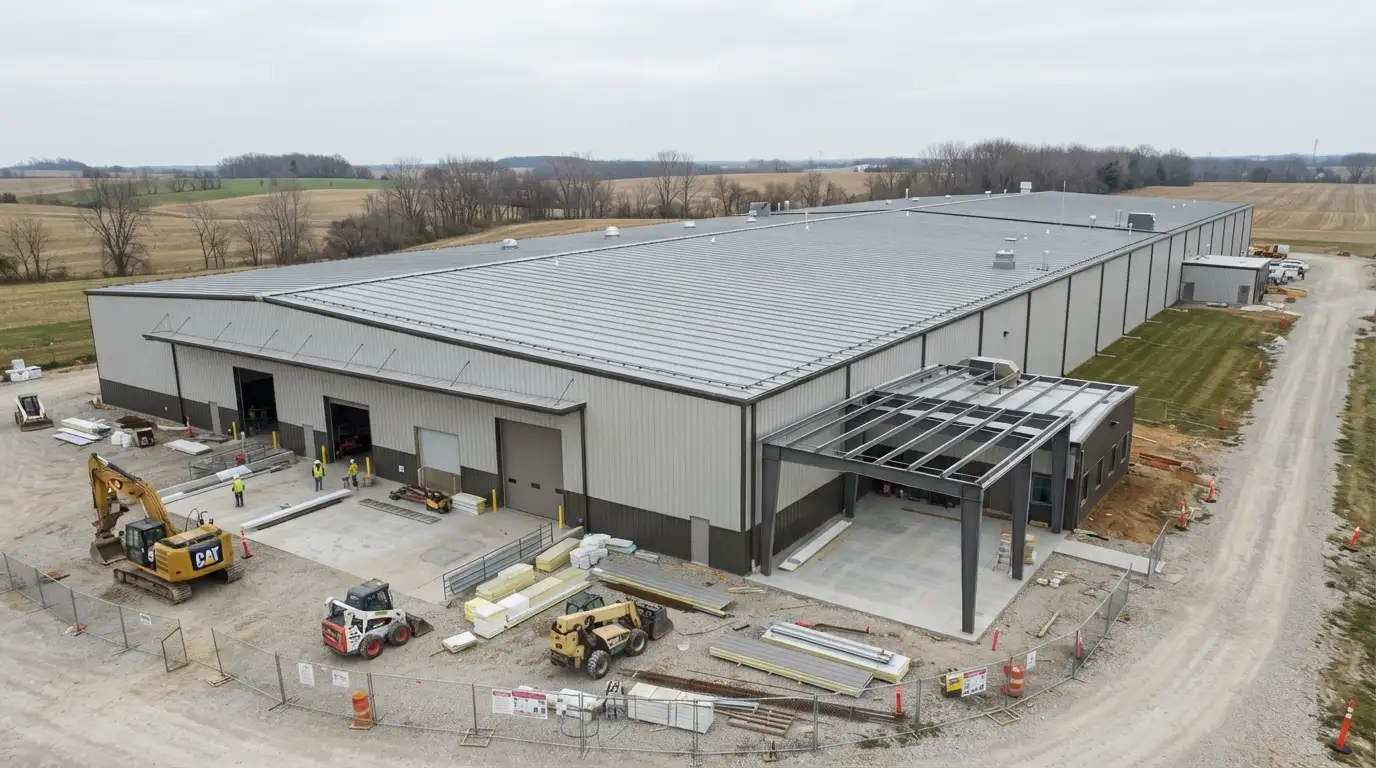
Most warehouses, strip malls, and factories have a roof that looks flat. So why do commercial buildings have flat roofs? The short answer is cost and use. A flat roof is cheaper to build over a big building, it gives heating and cooling equipment a place to sit, and it is safer for workers to walk on.
The roof is not truly flat, though. It has a slight slope so water can drain off. This guide explains how these roofs work, where they run into trouble, and what building owners in Central Minnesota should know about snow, ice, and metal roofing.
Are Commercial Flat Roofs Really Flat?
Commercial flat roofs are not perfectly flat. In the roofing trade, they are called low-slope roofs. They are built with a gentle tilt, often about a quarter inch of drop for every foot, so rain moves toward drains inside the roof or openings along the edge.
That small tilt matters. If the roof sags or the drains clog, water sits on the roof instead of draining. Standing water is heavy, and it wears down the roof surface faster than water that runs off. Most flat roof trouble starts here.
At a quarter inch of drop per foot, a 40-foot run gives the water 10 inches of fall. The slope is hard to see by eye, but it is enough to move water.
Some commercial roofs slope toward drains in the middle. Others slope toward the edges. The design depends on the building, and the goal is always the same: keep water moving off the roof. The word flat is just the shorthand most people use.
Why Flat Roofs Fit Large Buildings
Size is the biggest reason. On a wide building, a pitched roof needs a very tall peak and a much heavier frame. A flat roof covers the same space with a simpler frame and less material. A simpler roof is also faster to build. Crews can work across a level surface instead of a steep one, which cuts labor time and cost. For a business, a faster build also means the business can open sooner.
Appearance plays a small part. Most commercial buildings are designed for work, not for curb appeal, so owners rarely pay extra for a steep roof they do not need. Research on flat roof defects in commercial buildings says the same thing: these roofs are widely used to cut construction cost and save time. Size also multiplies every saving. A large building has thousands of square feet of roof to cover, so every extra step and every extra pound of material repeats across the whole surface. A small saving per square foot turns into a big one on the full roof.
Room for Heating, Cooling, and Other Equipment
Commercial buildings carry a lot of equipment: air conditioning units, exhaust fans, vents, and sometimes solar panels. A flat roof gives all of it a spot to sit. That frees up floor space inside and yard space outside, and it keeps the equipment out of reach of people on the ground.
Putting equipment on the roof also cuts noise at ground level and lowers the chance of damage from people walking by. The trade-off is more spots where water can get in. Every unit sits on a frame that has to be sealed to the roof, and every pipe or cable that passes through the roof is another weak point. That is why a good roof inspection always includes the area around the equipment.
Easier and Safer to Inspect and Repair
Steep roofs are hard to climb and risky to work on. A flat roof is a walkable surface, so inspectors, roofers, and repair crews can move around with less risk. That matters because regular checks are what keep a roof healthy. When a roof is easy to reach, small problems get found before they turn into leaks. If a roof does need work, such as roof and wall panel replacement, a level surface helps the crew finish faster and with less disruption to the business below.
Safety still comes first on any roof, flat or not. Every Systems West project meets OSHA and ANSI standards for commercial construction. A level surface removes some risks, but edges, skylights, and wet or icy patches still need care.
Space for Solar Panels, Green Roofs, and Future Additions
A level roof can hold solar panels, a rooftop patio, or a layer of plants. Some owners use the space for extra equipment as the business grows. Adding onto the building later is also simpler, because the new section can continue the same roof line.
A green roof is a layer of plants over a waterproof base. It soaks up rain and heat, and it only works on a level or nearly level roof. On larger mixed-use buildings, some owners even turn the roof into a lounge or event space that brings in extra income, though that is far more common in cities than on a farm or a factory.
Energy Costs and Insulation
A flat roof also gives owners room to work on energy bills. A light-colored or reflective top layer bounces sunlight back instead of soaking it up, which keeps the building cooler in summer. A flat surface also leaves room for thicker insulation, which slows heat loss in winter and heat gain in summer.
Insulation does one more job. It helps protect the roof deck from big temperature swings and from moisture forming inside the roof. Wet insulation does a poor job, so a leak should be fixed quickly instead of left for the next inspection.
How Flat Roofs Handle Water
Water leaves a flat roof through drains, through openings along the edge, or through gutters and downspouts. Many large commercial roofs skip gutters and use inside drains instead, which saves owners from cleaning long gutter runs. Metal buildings often do use gutters, and proper gutter and downspout installation protects roof edges, walls, and foundations from water damage.
No matter how the water leaves, the drains need to stay clear. Leaves, trash, and other debris block them, and a blocked drain leaves water sitting on the roof. There are three common ways to move water off a flat roof. Interior drains sit in low spots and send water down pipes inside the building. Scuppers are openings through the wall or edge of the roof that let water out, often into a downspout. Gutters catch water along the edge. Which one a building uses depends on its size and design.
Standing water is more than a nuisance. One inch of water on one square foot of roof weighs about five pounds. On a large roof, that adds up to many tons. Weight like that strains the roof, and water that sits for days wears down the top layer and finds weak spots.
A Short Look Back
Flat roofs are not new. People have built them for a long time in dry places. In the late 1800s and early 1900s, factories and warehouses used them to cover wide floors cheaply, and the practice continued as commercial buildings grew.
As roofing materials improved, flat roofs became easier to seal and cheaper to build. By the middle of the 1900s, when shopping centers, office parks, and schools spread across the country, the flat roof was the usual choice for wide buildings. It was never a style trend. It was the result of many practical decisions made over many years.
What Is Under a Commercial Flat Roof
A flat roof is a stack of layers. The deck is the base, usually steel, concrete, or wood. Insulation sits on top of the deck, and the waterproof top layer goes over that. Flashing, which is strips of metal or sheet material, seals the joints around edges, vents, and pipes.
The top layer comes in a few types. TPO and PVC are plastic sheets welded at the seams, and EPDM is a rubber sheet. Modified bitumen and built-up roofs use layers of asphalt. Spray foam hardens into a solid layer, and coatings can be applied over an old roof to add years to its life. The right pick depends on the building, the climate, and the budget. Seams and flashing are where leaks most often begin.
Metal Roofs on Low-Slope Commercial Buildings
Many warehouses, shops, and farm buildings have steel frames and metal roofs. Systems West also builds these frames through structural steel fabrication.
Metal roof panels come in long sheets that lock together at raised seams to keep water out. Many metal systems are made for low slopes, so a metal roof can look nearly flat and still shed water.
Metal and membrane roofs both keep water out, but in different ways. Membrane roofs rely on sealed seams across wide sheets. Metal roofs rely on panels that lock together, plus fasteners and flashing at the edges. Which is better depends on the building, its slope, your budget, and how long you plan to own it. If your building already has a metal roof, our crews handle metal building repair and roofing for commercial, industrial, and farm buildings.
On an older metal roof, check the seams between panels, the screws or clips, the edge trim, the flashing around vents and equipment, and the gutters and downspouts. Storm damage is a common reason for metal roof work, and replacing damaged or aged panels is a big part of what our crews do.
How Long Do Commercial Flat Roofs Last?
Most rubber, plastic, and asphalt flat roofs last about 15 to 30 years. The exact number depends on the type of roof, how well it was installed, and how well it has been kept up. TPO and PVC sheets last about 20 to 30 years. EPDM rubber lasts about 25 to 30 years. Modified bitumen runs about 15 to 25 years, and built-up asphalt roofs about 15 to 30. Spray foam lasts about 20 to 30 years when it is recoated on schedule. These figures are ranges, and the actual life of a roof varies.
Upkeep is what pushes a roof toward the high or low end of its range. A roof that gets inspected every year and cleared of debris tends to last longer than one nobody looks at until it leaks.
Common Problems With Flat Roofs
A steep roof drops water fast. A flat roof moves it slowly across a large surface, so it asks more of the owner. The research lists the usual fixes: good drainage, a regular maintenance plan, waterproof coatings or membranes, and clearing debris often. The study looked at buildings in a hot, humid climate, but the advice still fits anywhere water has to leave a roof.
Leaks usually start at seams, flashing, and spots where something passes through the roof. Standing water collects where a roof sags or a drain clogs. The top layer can crack, blister, or get punctured, metal panels can loosen at the fasteners, and clogged gutters can back water up against the roof edge.
Central Minnesota: Snow, Ice, and Freeze-Thaw
Winters here are long, and snow adds weight, so roofs and frames are designed to carry it. When snow melts during the day and freezes at night, ice can build up at drains and edges and block the path water needs to take. Wind also piles snow against walls and equipment, so some areas carry far more weight than the rest. Drains and edges deserve a look in late fall and again before the spring thaw.
A Simple Upkeep Routine
Check the roof at least once a year and after big storms. Clear the drains and edge openings, look for standing water, and check the seams and the flashing around vents and equipment. If water is still standing two days after rain, call a roofer. Look at the ceilings inside for stains, and keep a short record of inspections and repairs.
Upkeep follows the seasons. In fall, clear debris and check the seams before snow arrives. In winter, watch for ice at drains and edges. In spring, check for damage and clear the drains again. A roofer can also tell you whether a protective coating makes sense on an aging roof. Our crews handle repair and maintenance for commercial and farm buildings, and our team will inspect your facility and give clear recommendations.
Flat Roofs vs Pitched Roofs: Why Homes Look Different
Homes are small, so a steep roof is cheap to build, sheds rain and snow fast, and leaves an attic for storage. Commercial buildings are large and full of equipment, so a flat or low-slope roof makes more sense. These roofs suit warehouses, factories, shops, offices, schools, and farm buildings, though climate and drainage matter as much as roof type.
A pitched roof still makes sense in some cases, such as a building made for one special purpose, like a restaurant with a certain look, or a building that mixes a sloped front with a flat roof behind it. In places with very heavy snow, an owner may also weigh a steeper roof because it sheds snow on its own. If you are planning a new building, design, planning, and budget analysis is a good time to compare roof options.
Metal Building Repair and Roofing in Central Minnesota
Systems West has more than 50 years of experience with commercial, industrial, and farm buildings. We replace roof and wall panels, install gutters and downspouts, and work on Butler MR-24 roofs for customers in Litchfield, Hutchinson, Willmar, and St. Cloud.
If your roof is leaking, worn, or damaged from a storm, call 320-693-8779 or request a service quote.
Frequently Asked Questions
Why don't insurance companies like flat roofs?
Insurers pay close attention to flat roofs because leaks and standing water are common causes of claims. Rules differ by company, so ask yours what it wants to see, such as inspection records.
What are the downsides of a flat roof?
Water drains slowly, so ponding and leaks are the main risks. Seams, flashing, and clogged drains need regular checks, which means more upkeep than a steep roof.
How long do commercial flat roofs last?
Most last about 15 to 30 years, depending on the type of roof, the quality of the install, and how well it is maintained.
Why aren't houses built with flat roofs?
Homes are small, so a steep roof is affordable, sheds rain and snow quickly, and adds attic space. Big commercial buildings gain little from a steep roof and pay a lot more for one.
Can a metal roof be low-slope?
Yes. Many metal roof systems are made for low slopes. Check the maker's minimum slope before choosing one for your building.
How much slope does a commercial flat roof need?
Many roofs are built with about a quarter inch of drop per foot. The exact rule depends on the roof type and local building code, so check with your roofer or the maker's instructions.
Can you put solar panels on a flat commercial roof?
Yes. A level surface gives panels a good place to sit. The roof has to carry the extra weight and be sealed well where the mounts attach, so have a roofer review the plan first.
Should I remove snow from my flat roof myself?
Usually not. Walking on a snowy roof is risky, and the wrong tools can damage the roof surface. If you are worried about heavy snow or ice, call a roofer.
What is the best roof for a commercial building?
There is no single best choice. It depends on the size of the building, its slope, your climate, and your budget. A roofing contractor can look at the building and compare options with you.